


Syllabus: GS3/Science and Technology; GS2/IR
Context
- According to the Stockholm International Peace Research Institute (SIPRI) Yearbook 2026, India is estimated to have modestly expanded its nuclear arsenal in 2025.
Major Highlights
- Growing Dependence on Nuclear Weapons: Nuclear-armed states are placing greater emphasis on nuclear deterrence in their security strategies.
- This marks a reversal of decades-long efforts to reduce the role and number of nuclear weapons.
- Expansion and Modernisation of Arsenals: All nine nuclear-armed states, the United States, Russia, United Kingdom, France, China, India, Pakistan, North Korea and Israel continued modernization programmes and deployed new nuclear-capable systems in 2025.
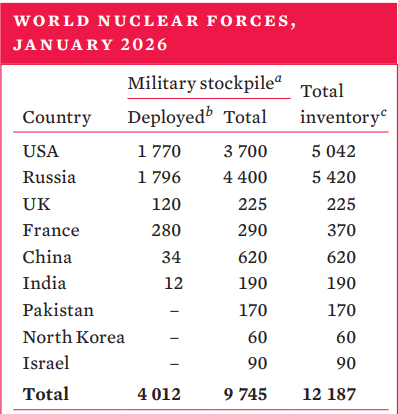
- Global Nuclear Stockpile: Estimated global inventory (January 2026): 12,187 nuclear warheads. Russia and the USA together possess around 83% of all stockpiled nuclear warheads.
- Declining Arms Control and Disarmament: Since the end of the Cold War, dismantling retired warheads generally exceeded deployment of new ones.
- SIPRI warns that this trend is likely to reverse as dismantlement slows and deployment of new weapons accelerates.
- Weakening Arms Control Regime: Strategic dialogue among major nuclear powers is declining.
- Rising Escalation Risks: Advances in missile technology, artificial intelligence, cyber capabilities, and space-based systems are complicating deterrence calculations. SIPRI warns that heightened geopolitical tensions increase the possibility of miscalculation leading to nuclear escalation.
- India-Specific Observations: India’s estimated nuclear arsenal increased to 190 warheads, up from 180 the previous year.
- India continues to modernize its deterrent through developments such as longer-range missiles, MIRV technology, and stronger sea-based nuclear capabilities.
- India’s strategic planning is increasingly influenced by China’s growing military capabilities, while the India–Pakistan nuclear rivalry remains important.
- Military Spending: India retained its position as the world’s fifth-largest military spender in 2025.
- India’s military expenditure at $92.1 billion, an increase of 8.9% over the previous year.
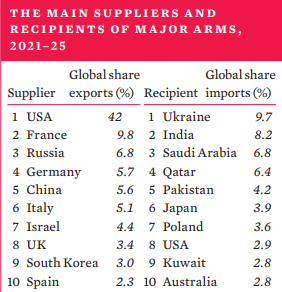
- Import of Arms: India also remained the world’s second-largest importer of major arms during the 2021-25 period, accounting for 8.2% of global arms imports.
About SIPRI
- SIPRI is an independent international institute dedicated to research into conflict, armaments, arms control and disarmament. It is based in Stockholm.
- It was established in 1966 and provides data, analysis and recommendations, based on open sources, to policymakers, researchers, media and the interested public.
- Funding: It was established on the basis of a decision by the Swedish Parliament and receives a substantial part of its funding in the form of an annual grant from the Swedish Government.
- The Institute also seeks financial support from other organizations in order to carry out its research.
Nuclear Disarmament
- It refers to the act of eliminating or abolishing weapons (particularly offensive arms) either unilaterally or reciprocally.
- It may refer either to reducing the number of arms, or to eliminating entire categories of weapons.
Treaties Related to Nuclear Disarmament
- Treaty on the Non-Proliferation of Nuclear Weapons (NPT): It was signed in 1968 and entered into force in 1970, the NPT aims to prevent the spread of nuclear weapons and promote disarmament.
- It divides the world into nuclear-weapon states (NWS), recognized as possessing nuclear weapons at the time of the treaty’s signing, and non-nuclear-weapon states (NNWS), which agree not to develop or acquire nuclear weapons.
- It requires NWS to pursue disarmament negotiations in good faith.
- India, Israel, North Korea and Pakistan have not signed the NPT.
- Treaty on the Prohibition of Nuclear Weapons (TPNW): Adopted by the United Nations in 2017 and opened for signature in 2018, the TPNW aims to prohibit the development, testing, production, stockpiling, stationing, transfer, use, and threat of use of nuclear weapons.
- It represents a significant step towards nuclear disarmament, although it has not been signed by nuclear-armed states.
- Comprehensive Nuclear-Test-Ban Treaty (CTBT): Opened for signature in 1996, the CTBT aims to ban all nuclear explosions for both civilian and military purposes.
- While the treaty has been signed by 185 countries and ratified by 170, it has not entered into force as nuclear-armed states must ratify it to become operational.
- Outer Space Treaty: This multilateral agreement entered into force in 1967 and bans the siting of weapons of mass destruction in space.
- All nine states believed to have nuclear weapons are parties to this treaty.
India’s Nuclear Weapons Program
- Smiling Buddha (1974): India conducted its first nuclear test code-named ‘Smiling Buddha’, and since then, it has developed a nuclear triad consisting of land-based, sea-based, and air based delivery systems.
- Operation Shakti (1998): India conducted a series of nuclear tests at Pokhran, codenamed ‘Operation Shakti’.
- It marked India’s formal entry into the nuclear weapons club.
India’s Policy Towards Nuclear Weapons
- No First Use: India has a declared nuclear no-first-use policy, under which it will not use nuclear weapons as a means of warfare unless first attacked by nuclear weapons.
- Non-Use Against Non-Nuclear Weapon States: India has committed to not using nuclear weapons against non-nuclear weapon states.
- Retaliation Only: India’s nuclear doctrine asserts that nuclear weapons are solely for deterrence and that India will pursue a policy of ‘retaliation only’.
- Multilateral Legal Arrangements: India is prepared to convert these undertakings into multilateral legal arrangements.
Source: SIPRI
Previous article
Inclusive Transformation of Vulnerable Sections in India
